
Cronton Church of England Primary Academy Believe Enjoy Succeed Together
Early Years Foundation Stage
At Cronton CE Primary School our KEYS Curriculum is built around the National Curriculum, enriched to reflect the children and community we teach in. The Early Years experiences provide the solid foundations children need at the beginning of their KEYS education. As a church school our Christian ethos and school values are the heart of everything we do.
We believe every child can be their BEST with our Vision statement reflecting this.
“I can do everything through God who gives me strength” Philippians 4:13
"Every child deserves the best possible start in life and the support that enables them to fulfil their potential.Children develop quickly in the early years and a child’s experiences between birth and age five have a major impact on their future life chances.” (DfE September 2021)
Cronton C.E. Primary Early Years Foundation Stage
At Cronton CE Primary School, our Early Years provision consists of a Nursery and Reception Class. We are committed to providing a high quality Early Years education which gives children a secure and confident start to their school life and nurtures a life long love of learning. We are fully committed to the purpose and aims of the Early Years Foundation Stage Framework 2021 that states:
"The Early Years Foundation Stage (EYFS) sets the standards that all early years providers must meet to ensure that children learn and develop well and are kept healthy and safe. It promotes teaching and learning to ensure children’s ‘school readiness’ and gives children the broad range of knowledge and skills that provide the right foundation for good future progress through school and life."
The Early Years provide the introduction to our school key learning attitudes. It develops values and the learning attitudes of INDEPENDENCE, PERSERVERENCE, CURIOSITY, TEAMWORK and RESPONSIBILITY so children learn to always be the BEST they can be.
Intent
- To provide a happy, caring, secure and stimulating learning environment to support and extend children's development and learning;
- To provide a broad, balanced and creative curriculum that offers opportunities for children to learn through planned, purposeful play in all areas of learning and development;
- To foster good partnerships with parents and carers, where they feel valued and are able to actively contribute to and participate in school life;
- To encourage confidence, independence and a desire to learn;
- To focus on the development of every child as an individual, valuing and building on their previous experiences and responding to their individual needs;
- To promote and celebrate achievement across all areas of the EYFS curriculum
- To provide quality and consistency across our setting.
- To provide a secure foundation through planning for the learning and development of each individual child and assessing and reviewing what the children have learned regularly.
- To provide equality of opportunity ensuring every child is included and supported.
By following the Statutory Framework of the EYFS and the four guiding principles that shape practice within Early Years settings we understand that:
- Every child is a unique child, who is constantly learning and can be resilient, confident and self- assured
- Children learn to be strong and independent through positive relationships
- Children learn and develop well in enabling environments, in which their experiences respond to their individual needs and there is a strong partnership between practitioners and parents and/or carers
- Children develop and learn in different ways and at different rates
Children learn skills, acquire new knowledge and demonstrate their understanding through the seven areas of learning and development. The EYFS curriculum provides a solid foundation for the school's KEYS curriculum.
There are three prime areas. These are:
- Communication and Language
- Physical Development
- Personal, Social and Emotional development.
These prime areas are particularly important for building a foundation for igniting children’s curiosity and enthusiasm for learning, forming relationships and thriving.
There are also four specific areas. These are:
- Literacy
- Mathematics
- Understanding the World
- Expressive Arts and Design.
Curriculum Maps
The Learning Environment
The EYFS learning environment is organised to allow children to explore and learn securely and safely. The environment is set up in learning areas, where children are easily able to find clearly labelled equipment and resources they need. These include designated areas for writing, numeracy, art and craft, role play, physical activity, construction, and small world area as well as a book corner, sand and water. These areas are carefully arranged to encourage quiet areas and more active areas within the learning environment. Children are encouraged to become independent learners and to take some responsibility for initiating their own lines of enquiry and investigation.
Our Early Years Foundation Stage has a well-resourced outdoor area for the children to learn. Being outdoors offers opportunities for children to do things in different ways and on different scales. It offers the children the opportunity to explore, use their senses and be physically active. Activities are planned for both inside and outside with children having the freedom to move between the two throughout the school day. The children can also move between Nursery and Reception classrooms during certain parts of the day.

Communication and Language
Intent
We believe that children’s spoken language underpins all seven areas of learning and development. Our intent is for:
- Every child to leave the Foundation Stage able to listen attentively for sustained periods of time.
- Every child to be confident in speaking to others within the wider setting and to larger groups of children e.g. performing in front of a school audience. They can express their own thoughts and ideas and taking into account the thoughts and ideas of others.
- Every child to be develop their ability from following simple one-step instructions to responding to more complex requests.
- Every child to develop a range of rich, new vocabulary which they will be able to use correctly in their speech and play. The children are introduced to topic specific vocabulary and are encouraged through modelling to use this language in their speech.
Implementation
Good listening and attention are encouraged throughout the Foundation Stage, across all areas of learning, through the modelling of clear examples for the children. All staff have high expectations of the children. Children understand what is expected of them when others are speaking and can expect to be listened to when they wish to speak. Through focused activities the children are encouraged to take turns in listening and speaking and this is extended into the continuous provision through staff offering low level support or prompts when needed. Children’s understanding is developed through careful use of questioning and dialogue both in focused and child led activities. Children are encouraged to speak to each other, through partner talk and many opportunities to speak to groups or the whole class. Correct speech is modelled at all times by the staff and any inaccuracies in the children’s speech are corrected through the use of modelling back to them in conversation. Children having difficulty with speech and language are identified early as possible, and activities and interventions are put in place or a referral to speech therapy is made if appropriate. Programmes for those children are delivered in school, often in small groups where other children can also benefit. Talk is used by the children every day to rehearse plans of action, share experiences and ideas, play imaginatively and organise co-operative projects in their play. New vocabulary is introduced through all areas of learning and revisited. Staff model using these new words in sentences and the children are encouraged to model this in their own sentences.

Personal, Social and Emotional Development
Intent
At Cronton C.E. we believe that the personal, social and emotional development of the children underpins every aspect of learning within our Foundation Stage. It is vital to enable children to lead healthy, happy lives. Our intent is for:
- Every child to leave the Foundation Stage with a positive attitude about themselves and those around them.
- Every child to feel a valued member of the class and shape their own identity through an increasing awareness of their own needs and the needs of others.
- Every child to develop the ability to make the right choices and learn to reflect on their own behaviour. They learn to compromise, form strong friendships and develop positive dispositions to learning, cooperation and communication.
Implementation
Personal ,social and emotional development underpins all aspects of a child’s daily life at school. We have a rich variety of approaches which aim to support children’s progress towards the ELG. These include regular circle times and our school wide use of the Good to be Green behaviour policy. We use JIGSAW as a scheme to base our PSHE teaching on to ensure all aspects of a child’s PSED development are taught directly, alongside our Christian Values, focusing on one topic every half term. British values are incorporated into our curriculum. Staff encourage children in their development through modelling what is expected and supporting children in their interactions with others. This is further developed through our Gardener and Seedling Project, where children are 'buddied up' with a Year Five child and work with them over two years. On entry and at the end of every term we assess children’s levels of well-being and involvement by using the Leuven Scales This helps us to identify children who may need extra support in accessing the experiences and opportunities in the setting and allows for activities and appropriate help to be put in place.

Physical Development
Intent
Physical development is vital in enabling children to pursue happy, healthy lives. Our intent is for :
- Every child to develop and practise the control they have over their own bodies. They develop the confidence and skill in large gross motor movements such as running, jumping, climbing, swinging, hanging etc.
- Every child to develop their spatial awareness and coordination, whilst at the same time encouraging the fine motor skills that they will need to develop holistically.
- Every child to become independent and manage their own self –care. They have developing understanding of how their bodies work and what they need to be healthy and safe, (including knowing when they are hungry, cold, hot or thirsty, etc.) and how they are able to best meet these needs.
- Every child to understand how physical activity can support their mental health.
Implementation
Children have daily opportunities to practice, develop and challenge their physical development. Outdoor provision is accessed daily and the children learn to put on appropriate clothing and footwear independently. Weekly P.E. sessions teach the fundamentals of movement such as spatial awareness, body control, directional work and listening skills. Sessions introduce basic skills in gym, games, dance, athletics and the use of small equipment. Discreet development of fine and gross motor skills is implemented through the curriculum and continuous provision. Children make healthy decisions about lunch and snack choices. They are encouraged to develop independent self-management skills with hygiene and changing for in-school activities. Through collecting observational evidence and evaluating focused activities, children who may need more support or practise are quickly identified and appropriate activities and enhancements are put in place.

Literacy
Intent
At Cronton C.E. our intent is for every child to become a confident reader and writer and to enjoy both aspects of Literacy.
Comprehension and Word Reading:
- For every child to leave the Foundation Stage with a wide experience and knowledge of fiction and non-fiction books. They understand the difference between the two and use associated terms. E.g. traditional, character, author, cover, blurb, contents page, fact.
- For every child to know that print carries meaning and to talk about their favourite books and authors and compare stories for similarities and differences.
- For every child to be able to discuss a character’s thoughts, feelings and actions and make predictions about events in the story or retrieve basic information from a text.
- For every child to develop the phonetic and word reading skills to enable them to read a text fluently at an appropriate level.
Writing:
- For every child to leave the Foundation Stage understanding that writing can have many different purposes; lists, letters, invitations and stories. They understand that it is another way for us to communicate.
- For every child to compose and write a sentence independently using some correct spellings for common words and appropriate letter/sound correspondences in other words they wish to use.
Implementation
Topics of learning, both child and adult led, are explored predominantly through stories and non-fiction books in daily literacy sessions and the children are encouraged to develop a range of skills to help them learn to read and enjoy books. The children explore character’s thoughts and feelings, plots of stories and new vocabulary is explained and modelled. The school follows the Read, Write, Inc programme of synthetic phonics, which is delivered daily. In Nursery children focus on aural awareness of sounds and words before moving on to some single letter/sound correspondences in the Summer Term. In Reception children are taught to blend and segment and read words on sight and to spot them in the books we share together in both daily story times and through more focused daily literacy inputs. Children choose library books weekly to take home and share and have reading books linked to their phonetic development. Sound Books and Sight (Red) Word books in Reception ensure that the children can share their learning at home and practise regularly.
The books we read are used as a stimulus for our writing activities – both focused and through enhancements in the continuous provision. Children are encouraged to explore mark making and writing with many different media across the provision, developing their muscles and co-ordination as appropriate. Correct letter formation is taught discreetly and encouraged in all mark making. An effective tripod grip is modelled and encouraged.
Reading and mark making opportunities are provided throughout the early year’s classrooms and the outdoor provision.
Through collecting observational evidence and evaluating more focused activities, children who may need more support or practise are quickly identified and appropriate activities, enhancements and interventions are put in place.

Mathematics
Intent
Confidence and competency in mathematics is an essential life skill. Our intent is for:
- Every child to become a confident mathematician, able to explore mathematical concepts and numbers and to use mathematical language fluently.
- Every child to be confident to apply their knowledge and use developing reasoning skills to solve problems.
- Every child to be familiar with the names and properties of common 2D and 3D shapes. They should be able to demonstrate an understanding of pattern and use correct simple vocabulary to describe and order items in terms of height, length, capacity, time or weight.
- Every child to develop positive attitudes and interests in mathematics.
- For every child to look for patterns and relationships, spot connections, ‘have a go’ talk to adults and peers about what they notice and are not afraid to make mistakes.
Implementation
In Nursery the series Numberblocks is used as basis for learning about number. In the Reception Class we follow the White Rose Mastery Medium Term Plans. Mastery is used as an approach throughout the Early Years with a focus on practical activities. Concrete resources are always available and modelled to use alongside pictorial resources. More abstract representation is introduced alongside these in the Reception Year as the children become ready. Mathematics inputs are delivered daily and activities are a balance of adult directed, focused activities and child initiated learning. Continuous provision is enhanced with related resources to enable the children to explore and develop their understanding and complete challenges. This enables the children to have the opportunity to further practise and develop concepts and strategies that are explicitly taught. Mathematical games are used on the interactive board and are placed on the i-pads for the children to go on if they wish. We have a short, fun Maths Meeting at the start of every day, where we practise our number writing, oral counting, shape recognition and days of the week. There is an emphasis on the development of mathematical language, clearly explained to the children and modelled for them. The children are encouraged to use the correct terms and vocabulary they have learned in their activities. Through collecting observational evidence and evaluating more focused activities, children who may need more support or practise are quickly identified and appropriate activities and interventions are put in place.

Understanding the World
Intent
Our intent is for:
- Every child to be confident in exploring, learning about and making sense of the world they live in, their families and community.
- Every child to be able to observe, solve problems, question, make decisions, experiment, predict, and plan in a variety of contexts and develop an understanding of past and present.
- Every child to find out about their environment, talk about the changes they see happening around them and make links between their experiences and knowledge.
- Every child will develop their senses, understanding and awe of their world.
- Every child will also explore the uses and impact of information and communication technology on their everyday lives.
Implementation
Children learn and play in our outdoor area daily and are encouraged to talk about what they see and find. Through collecting observational evidence and working in focused activities, children who may need more support or practise are quickly identified and appropriate activities and enhancements are put in place. Activities based around celebrations such as Divali, Chinese New Year and World Book Day provide opportunities to explore other countries, their cultures and the differences in people’s lives around the world. Learning about events such as The Gunpowder Plot when celebrating Bonfire Night allow them to develop an understanding of events that happened a long time ago at a simple level. Through accessing the outdoor provision they observe and explore seasonal changes. Activities linked to aspects of learning are set up through continuous provision. Visitors, usually linked to an area of learning, and a visit off site in Reception, enhance the curriculum. Children are encouraged to share their experiences outside of school and talk about their families through the Busy Books which are shared weekly. The use of technology underpins daily learning where appropriate and children have access to i-pads, the computer and the interactive board. Children are taught safety online from the start of their school experiences.

Expressive Arts and Design
Intent
- For every child to explore and share their thoughts, ideas and feelings through a variety of art, design and technology, music, movement, dance, imaginative and role-play activities.
- For every child to be confident to experiment with different media, resources and a rich range of creative activities which will inspire and stimulate their creativity and motivation to move their learning forward.
- For every child to have pride in their creative achievements.
- For every child to know a variety of songs and nursery rhymes and can explore beat and rhythm using their bodies and musical instruments.
Implementation
We facilitate a creative, topic based curriculum which helps children develop learning opportunities within an engaging, secure and interesting environment. Direct adult led activities such as dance, role-play and stories, ignite children’s creativity which they further explore through provision and child-led activities. The children are encouraged to explore different media, find different ways of combining materials and are taught some skills explicitly, allowing them to develop these in their own work. We use Music Express and Chranga to supplement our teaching of music and singing. Through collecting observational evidence and evaluating focused activities, children who may need more support or practise, are quickly identified and appropriate support and activities are put in place.
Characteristics of Effective Learning
Within the Statutory framework for the Early Years Foundation Stage they identify three “Characteristics of Effective Teaching and Learning”; these characteristics encompass children from birth to the end of the Reception Year and children will demonstrate them in different ways depending on the developmental level of the child: We monitor and report on these in the end of year report, alongside the prime and specific areas.
- Playing and exploring – children investigate and experience things and “have a go”.
- Active learning – children concentrate and keep on trying if they encounter difficulties and enjoy their achievements.
- Creativity and thinking critically – children have and develop their own ideas and make links between ideas. They develop strategies for doing things.
Progress and achievement in the Characteristics of Effective Learning are reported to parents but not formally assessed.
Parents as Partners
We appreciate that parents are children’s first educators and we value the contribution they make.
We understand the role that parents have played, and their future role, in educating the children. We do this through:
- Contact with all children’s prior learning environments before they start school.
- Providing an opportunity for parents and children to a Stay and Play before they start our school. This provides an opportunity for staff and parents to discuss the child and any additional needs or medical issues they might have.
- Providing all children with the opportunity to visit our school, so children have
- time to meet their peers and the EYFS staff team before starting school;
- Sharing observations with parents.
- Inviting all parents to parent’s evenings to talk about their child’s progress;
- Providing parents with opportunities to contribute to their child’s learning journey through the Busy Book and Evidence Me.
- Arranging a range of activities throughout the year that encourage collaboration between child, school and parents: For example, Stay and Play and Sports Day.
Assessment in the Foundation Stage
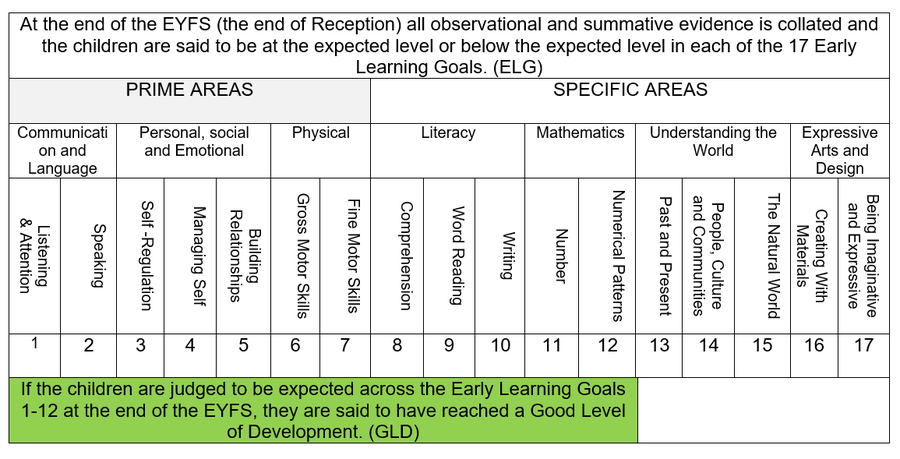
The seven areas of learning (please see above) contain seventeen Early Learning Goals (ELGs) and evidence of the children’s achievement is gathered for each of these. Evidence for judgements is collected through observations from the continuous provision, observations during focused activities and some summative assessment tasks. Much of this evidence is collated using the 2Simple app – Evidence Me.
- Observations are shared termly with parents and children’s progress is shared with parents/carers twice a year through Parent’s Evenings and finally in an end of year report. Parents are provided with a further opportunity to discuss the end of year outcomes should they wish to after receiving their child’s report or provide feedback via a written form.
- Progress in Nursery and Reception is plotted termly on a simple tracking document and children can be assessed as meeting the expected levels of development or not yet reaching the expected levels of development for that period of learning. This allows for effective future planning.
- Parents are encouraged to help build up a picture of their child by commenting on activities or progress at home, through learning stories, busy books, news books and reading records.
- The children in the nursery are assessed from our first contact with them. Before the children start, the parents are given the “Starting at Cronton Nursery” booklet to find out the child’s early years experiences and their basic skills in Numeracy and Literacy.
- Children are assessed on entry to Reception using NFER Baseline assessments primarily in Mathematics and Communication, Language and Literacy (CLL).
- Phonics progress is monitored through ongoing formative assessment, initial and summative phonic assessments at the end of a sound set. (Read Write Inc.)
Assessment at the End of EYFS
- The EYFS profile is completed for each child by the end of June in the Reception year. The profile provides information about each child’s knowledge, understanding, abilities against expected levels and readiness for Year 1. This assessment is completed against the criteria set out in the Early Learning Goals. Practitioners must assess whether a child is working at the expected level or whether they have not yet met the expected level.
- Profiles are completed for all pupils, including those with special educational needs and disabilities although reasonable adjustments are made as necessary.
- Profiles and additional commentary on characteristics of learning are shared with Year 1 teachers to inform planning and preparation for entry to KS1.
- The school has a statutory requirement to report outcomes from the EYFS profile to the local authority which then has a duty to return this data to the relevant Government department. The local authority conducts moderation of the profiles regularly, on a rotational basis, with each school in its catchment.
- Parents of children in Nursery and Reception receive a written report at the end of the Summer Term outlining the children’s progress and attainment across the Prime and Specific areas and characteristics of effective learning.
Impact
Our curriculum enables our children to develop into well rounded individuals who embody our values and carry with them the knowledge, skills and attitudes which will make them lifelong learners and valuable future citizens. We endeavour for pupils to be Key Stage 1 ready and have our school values embedded by the time they leave reception, preparing them for their future.
‘EYFS teachers have good subject knowledge and this is evident in how concepts are presented but also in how areas are used to develop and build on prior learning. Lessons planned engage and enthuse the children and because of this behaviour for learning is excellent.’ (LDST Review 2019)
‘The EYFS provision is well-resourced and children are fully engaged in their learning. They thrive in the enabling environment which supports independence through high expectations and challenging activities and encourages communication, problem solving and reasoning. All adults understand their roles and through high expectations are effective in moving learning on, leading to consistently high outcomes.’ (LDST Review 2019)
The impact of our curriculum is measured by assessment procedures which allow us to measure outcomes against all schools nationally. We measure the percentage of pupils achieving age related expectations throughout the academic year and put supportive interventions in place if and when needed. Class teachers use observations to make formative assessments which inform future planning and ensure that all children build on their current knowledge and skills at a good pace. Summative assessment compares children attainment to age related expectations in Development Matters. This is tracked to ensure rates of progress are at least good for all children, including vulnerable groups such as those with SEND, disadvantaged or summer born children.